As a cohort we came up with a list which of ideas that we thought were essential for student engagement. This is my ranked list ranked from most important to least.
1. Purposeful- Ensure that the technology and activities relate to the
task/learning and will enable meaningful learning
2. Choice about how they work, autonomously or collaboratively
3. Provide a variety of technology mediums for delivering information and instructions
4. Cultivation of on-line presence so participants feel like they are communicating with people they know.
5. Prompt, detailed and personal feedback was what ended up being the
most significant for my online class. Also providing a choice of
platforms to access and submit work.
6. Feedback from peers and tutors.
7. Provide access to real-life data from online source.
9. User Testing - Test your activity with actual users or close to actual users.
10. Apply online communication and F2F opportunities to connect learners with external support and experts
It was difficult locking in my final rankings but I think purposeful
technology is a strong component in student engagement, followed closely
by giving children choice about how they work. Learning is enhanced
when students are encouraged to talk with their peers and technology
enables learners to communicate with people in different classrooms
anywhere in the world, a powerful tool to support peer to peer
networking (McLoughlin & Lee, 2008).
Showing posts with label learner engagement. Show all posts
Showing posts with label learner engagement. Show all posts
Learner Engagement Pitfalls - Artefact 7
Describe (a) the situation or context including how much experience with
teaching and technology that you had at the time (b) the reason for the
learner activity (learning outcomes, how it links with other curriculum
areas, etc). (c) what you did (or didn’t do) (d) the result and (e)
what you learned from it.
For a whanau team building activity I set up a QR code scavenger hunt around our school grounds. Students had to scan the red QR code to receive a challenge they had to complete as a team and then scan the blue QR code to receive the clue to the next QR code. Children were initially excited and eagerly headed off to complete the scavenger hunt but as the activity progressed it was evident most children had disengaged from the activity. One child was typically in control of the device scanning the codes which meant the other children were just along for the ride. Other groups scanned all of the codes and failed to complete the tasks in sequence, rather they scanned them and then tried to complete them all at once. I found that many of my year 1 students spent the time picking daisies or just running around with their group as the older students took charge as they knew what they were doing.
Looking back on this activity with some more pre-teaching and setting the scene it has the potential to be an engaging activity. Perhaps it should be done in smaller groups or done in classes rather than a whanau of four classrooms.
A QR scavenger hunt was an enthusiastic way to carry out a scavenger hunt and the same issues might have occurred regardless if the clues had be written out for the children to read. Next time before setting children out on the hunt some common understandings need to be established; ensuring all group members are included, tasks have to be completed in the order you find them, all team member need to be involved in the challenges.
For a whanau team building activity I set up a QR code scavenger hunt around our school grounds. Students had to scan the red QR code to receive a challenge they had to complete as a team and then scan the blue QR code to receive the clue to the next QR code. Children were initially excited and eagerly headed off to complete the scavenger hunt but as the activity progressed it was evident most children had disengaged from the activity. One child was typically in control of the device scanning the codes which meant the other children were just along for the ride. Other groups scanned all of the codes and failed to complete the tasks in sequence, rather they scanned them and then tried to complete them all at once. I found that many of my year 1 students spent the time picking daisies or just running around with their group as the older students took charge as they knew what they were doing.
Looking back on this activity with some more pre-teaching and setting the scene it has the potential to be an engaging activity. Perhaps it should be done in smaller groups or done in classes rather than a whanau of four classrooms.
A QR scavenger hunt was an enthusiastic way to carry out a scavenger hunt and the same issues might have occurred regardless if the clues had be written out for the children to read. Next time before setting children out on the hunt some common understandings need to be established; ensuring all group members are included, tasks have to be completed in the order you find them, all team member need to be involved in the challenges.

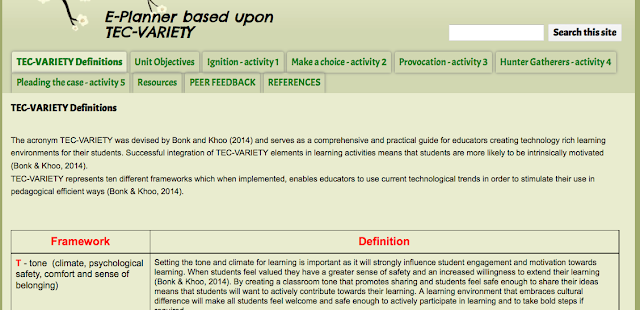
TEC-VARIETY-lightbulb moment - Artefact 6
Assignment two provided me with many
light bulb moments, and gave me theoretical confirmation of my current teaching
practice using technology as well as igniting my desire to do more.
The TEC-VARIETY model was new to me and
once I understood what it was I could see straight way the impact it could have
upon my classroom. Having greater knowledge of learner motivation provides insight into why learners are sometimes more successful than others in their learning journey (Bonk & Khoo, 2014). Applying the TEC-VARIETY framework to my unit planning forced me to think more carefully about the types of technology and why. There have been times when I have encountered a new online tool or a new piece of technology and have rushed into using it without thinking "can this enhance my students learning? I will be using the TEC-VARIETY framework when I am planning my learning in the future as making learning activities purposeful will focus students energy and efforts towards their desired goals (Bonk & Khoo, 2014).
Making connections to my teaching context - Artefact 5
 | ||
| Negotiated Learning Model at Summerland Primary School (2013) |
Taking into consideration my new understandings I would make slight changes to this model.
Student engagement would be placed in the central circle as negotiated learning puts students at the centre of learning and McCombs and Vakili (2005) stated that this fosters positive relationships between teachers and students built on mutual respect and compassion.
Technology has been added to the background of the diagram, showing the seamless integration and role that technology plays in the learning. It is there as a tool to enhance learning, it is not being used for the sake of it.
 |
| Adapted model (2016). |
Subscribe to:
Posts (Atom)